The Invisible Safety Risk: How Worker Stress Impacts Productivity and Construction Safety
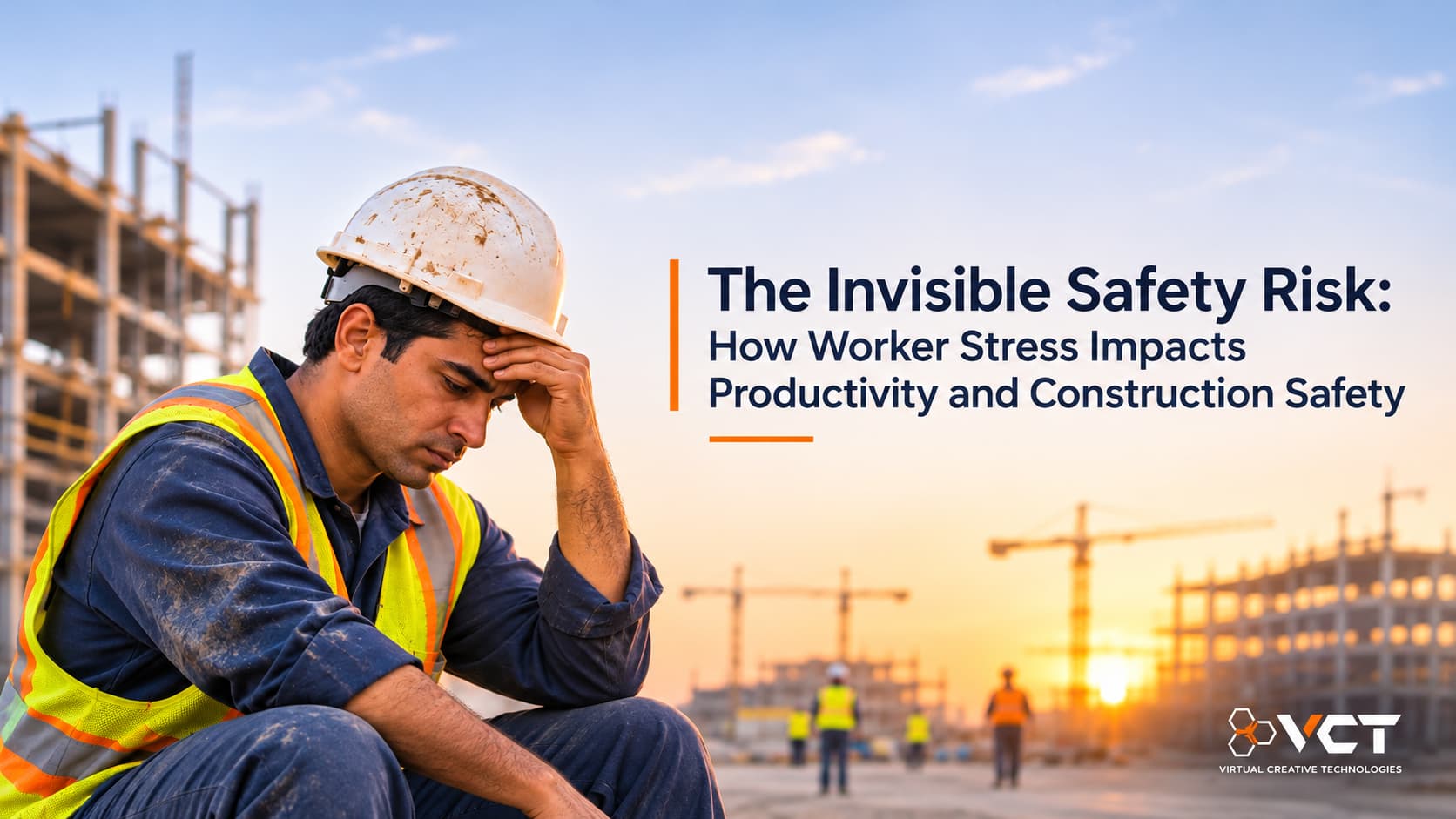
When stress increases, productivity suffers, judgment weakens, and the invisible safety guardrails protecting workers begin to disappear.
The construction industry invests billions in safety equipment, training, protective systems, and accident prevention. Yet one of the most significant risks to workforce safety and productivity remains largely invisible: worker stress.
A worker may be wearing all the required protective equipment, following established procedures, and operating in a well-controlled environment. But if that worker is experiencing significant stress, exhaustion, or psychological pressure, their ability to recognize hazards, make decisions, and respond to danger may be compromised.
For construction executives and project leaders, this raises an important question: Are we doing enough to protect workers from the risks we cannot see?
Acute and Chronic Stress: Why the Difference Matters
Acute stress is the body’s immediate response to a challenge or threat. It can temporarily sharpen alertness and help a worker respond to an unexpected hazard. But repeated high-pressure situations, particularly without sufficient rest, can become harmful.
Chronic stress develops when pressure persists over weeks or months. Excessive workloads, long shifts, job insecurity, and separation from family can contribute to sleep problems, fatigue, reduced concentration, and declining work performance. For project leaders, the concern is not simply a stressful moment, but the cumulative effect on workers and teams.
A Mental Health Crisis the Industry Cannot Ignore
The statistics are alarming. In a September 8, 2026 Science Bulletin titled “Preventing Construction Worker Suicide,” the U.S. National Institute for Occupational Safety and Health (NIOSH) reported that more than 5,000 construction workers die by suicide annually in the United States. Construction workers are approximately five times more likely to die by suicide than from a workplace injury.
A separate CDC study, published in December 2023 using 2021 data, found that male workers in construction and extraction occupations experienced a suicide rate of 65.6 deaths per 100,000 workers, more than double the overall rate among male workers.
These figures reveal a serious challenge facing an industry characterized by demanding schedules, physically exhausting work, financial pressures, and, in many cases, prolonged separation from family.
Suicide is complex and cannot be attributed to workplace stress alone. Nevertheless, these statistics demonstrate why psychological wellbeing deserves the same management attention as physical safety.
We cannot claim to protect workers while overlooking their mental wellbeing.
The Hidden Cost of Stress on Productivity
Stress is not only a human concern. It has measurable economic consequences. The World Health Organization estimates that depression and anxiety result in approximately 12 billion lost working days globally every year, costing the global economy around $1 trillion in lost productivity.
For construction projects, the implications are significant. Stress and associated fatigue can affect concentration, motivation, decision-making, communication, and work quality.
A stressed workforce may experience more mistakes, increased rework, reduced coordination, and declining productivity.
Consider a project already behind schedule. Management increases working hours to recover lost time. Workers become increasingly fatigued and stressed. Productivity begins to decline, mistakes increase, and additional pressure is applied to compensate.
What begins as a scheduling problem can develop into a cycle of declining productivity and increasing safety risk.
Working longer does not necessarily mean producing more, especially when workers are physically and mentally exhausted.
For executives managing major capital projects, workforce wellbeing should therefore be viewed as a factor influencing project performance, cost, schedule reliability, and safety, not simply an employee benefit.
When Stress Weakens the Worker's Safety Guardrails
Every construction worker operates within multiple layers of protection. Some are physical: helmets, harnesses, barriers, and safety equipment. Others are procedural: training, supervision, permits, and established safety practices.
But there is another essential layer of protection: the worker’s own ability to recognize danger, assess risk, maintain concentration, and react appropriately. These are the invisible safety guardrails.
Research from NIOSH confirms that fatigue, which can be associated with stress, can reduce attention, slow reaction times, impair judgment, and affect short-term memory.
Imagine a worker operating near heavy machinery. The equipment is functioning correctly. Safety procedures are in place. The worker has received appropriate training. Yet prolonged stress and fatigue may cause that worker to overlook a warning, misjudge a movement, or react too slowly to an emerging hazard.
Nothing about the physical environment has changed. What has changed is the worker’s ability to respond safely within it.
This is why traditional safety measures, while essential, cannot address every human factor contributing to workplace accidents.
Importantly, workers should never be blamed for organizational conditions that create excessive fatigue or psychological pressure. Employers must maintain effective safeguards even when human attention is imperfect.
One Stressed Worker Can Affect an Entire Project
Construction safety depends on teamwork. Crane operators depend on signalers. Workers depend on supervisors. Entire teams depend on accurate communication and coordinated decisions.
When stress affects one worker, the consequences may extend beyond that individual. When it affects an entire team, the potential impact becomes considerably greater.
Under excessive pressure, communication can deteriorate, warning signs may be overlooked, and workers may become less willing to question unsafe decisions.
On large construction and industrial projects, where thousands of workers operate simultaneously, these small failures can combine into serious safety risks.
A workforce under pressure may appear productive while its collective safety margin is steadily shrinking.
This is a risk that traditional safety statistics may not reveal until something goes wrong.
A New Approach: Understanding the Human Behind the Hard Hat
For decades, construction safety has focused primarily on external hazards. We monitor equipment, inspect workplaces, enforce procedures, and investigate incidents. But how well do we understand the physical condition and wellbeing of the people performing the work?
Advances in wearable technology are creating opportunities to improve this understanding.
Connected safety devices can monitor physiological and environmental indicators such as heart rate, heart-rate variability, physical activity, temperature, and exposure to potentially hazardous conditions.
When interpreted alongside working conditions, individual baselines, worker feedback, and appropriate occupational health assessments, these indicators can provide useful context about physical strain and potential fatigue-related risks.
At Virtual Creative Technologies (VCT), our True InSite platform combines connected wearable technology, physiological measurements, environmental monitoring, and worker location information to support a more comprehensive approach to workforce safety.
Our vision extends beyond tracking workers or responding to accidents. We believe technology should help organizations better understand the conditions affecting their workforce, recognize emerging risks, and support earlier preventive action.
This approach complements established safety systems, responsible workforce management, and occupational health programs.
The future of construction safety is not simply about monitoring the environment around workers. It is also about understanding the conditions affecting the workers themselves.
Worker Wellbeing Is a Leadership Responsibility
For CEOs, project directors, and HSE leaders, the message is clear. Worker stress is not an isolated personal issue. It can influence productivity, operational performance, teamwork, and workplace safety.
Organizations that overlook workforce wellbeing may be overlooking an important source of operational risk.
Addressing this challenge requires more than technology. It requires reasonable workloads, adequate rest, supportive supervision, accessible mental health resources, and a culture where workers can raise concerns without fear.
Technology can strengthen these efforts by providing additional information to support informed decisions. But meaningful progress begins with leadership.
A safer workforce is better positioned to be a productive workforce. And a workforce that feels supported is better equipped to deliver successful projects.
At Virtual Creative Technologies, we believe the next advancement in industrial safety must place the human being at the center of every safety strategy.
Because behind every helmet is a person. And protecting that person is the foundation of every successful project.
References
1. CDC / NIOSH (September 8, 2026). Preventing Construction Worker Suicide.
https://www.cdc.gov/niosh/bulletin/2026/suicide-in-construction.html
2. CDC (December 15, 2023). Suicide Rates by Industry and Occupation, United States, 2021. MMWR 72(50), 1346–1350.
https://www.cdc.gov/mmwr/volumes/72/wr/mm7250a2.htm
3. World Health Organization. Mental Health at Work.
https://www.who.int/news-room/fact-sheets/detail/mental-health-at-work
4. CDC / NIOSH. Fatigue and Work.
https://www.cdc.gov/niosh/fatigue/about/index.html